What happens when you learn to really listen to one another?
23 September 2026
In the interdisciplinary elective course ‘Bridges, not Walls: Dialogue in Times of Polarisation’, you don’t learn how to win an argument, but how to avoid automatically act defensive. You learn to make space for the other person’s perspective as well as for your own response, particularly when a conversation becomes tense.
For anthropology student Daan, it was precisely the latter that came as a surprise. “This is a course you take not just for your degree, but also for yourself.”
A course that hits closer to home
Daan chose the course because he is interested in mediation and enjoys working with people. He mainly expected to tackle conflicts in a practical way, but soon discovered that dialogue is something different:

Dialogue isn't so much about what people think or how to resolve a conflict. It's about a different way of looking at things—about being able to accept that the other person thinks that way.
Under the guidance of lecturer Judith van den Boogert, students dive into the theory behind conflict and polarisation, but above all into the practical aspects. They practise conducting safe dialogues, design and facilitate a dialogue themselves on a socially charged topic, and reflect on what they learn along the way – about others and about themselves.
In doing so, they work on various Inner Development Goals, such as empathy, courage and trust. Not as qualities that you ‘possess’ by the end of the course, but as skills that you practise and develop time and again.
The person behind the opinion
One exercise from one of the first lessons really stuck with Daan. Students shared a childhood memory in which they felt happy or content.
“At first I thought: nice question, but what are we going to learn from this?” It soon became clear what the exercise achieved. “You could see how people opened up and beamed as they talked about what they’d experienced. Afterwards, you immediately felt much more connected to one another and listened differently to what someone was saying, because you saw them as a person.”
That changed his view of differences of opinion. “You’re a human being and you have certain ideas, but those ideas aren’t the same as who you are as a person.”
That realisation also changed how Daan himself reacts in a discussion. “I used to get into a discussion more easily and quickly, because I identified someone with what they were saying. Now I try to look at the person first.”
Making room for difference
According to Daan, the essence of dialogue is not about agreeing with one another, but about making space for different perspectives. Even if that means taking a step back yourself.
“It’s very important to consciously create a space where people feel at ease and aren’t afraid to speak up, even if someone disagrees with them.”
During the course, Daan also learnt something about himself. In group assignments, he naturally tends to take the stage: he has lots of ideas and enjoys sharing them. Whilst preparing for a dialogue, he noticed a fellow student who, on the contrary, let everyone have their say, including those who are less likely to speak up of their own accord. “I realised that it was precisely those voices that came up with good ideas. That certainly taught me something about my own personality.”
Since then, he has been trying to listen more consciously, even when he strongly disagrees with something. “I still feel the urge to react straight away. But that doesn’t always get you anywhere.”
For Daan, that is one of the most important lessons of the course: engaging in dialogue doesn’t mean you have to let go of your own convictions, but that you don’t have to react automatically based on those convictions.
The basis for a good conversation
The course brings together students from a variety of backgrounds, ranging from anthropology and history to psychology and neurobiology. It was precisely these differences that made the discussions so interesting.
“It doesn’t matter what you’re studying,” says Tonko. “It’s simply about how we, as people, interact with one another.”
According to Tonko, a good dialogue begins with establishing a shared foundation. “It starts with setting ground rules, and you hardly ever do that in a university setting. People assume that certain norms and values go without saying.”
That is why, at the start of the course, the group drew up a code of conduct together: let each other finish speaking, respect other people’s perspectives, even if you disagree with them, and set aside your own preconceptions.
Throughout the course, these agreements form a shared foundation that students can fall back on when a conversation becomes tense.
When dialogue turns into an argumentA group assignment on negotiation made Tonko realise, quite literally, just how great the difference can be between a dialogue and a discussion. In a small group, the students first discussed an ethical issue. Everyone listened to one another and tried to understand why someone had made a particular choice.

That’s when you find out what someone values. And that’s neither good nor bad; it’s just the way it is.
But as soon as Tonko, representing his group, joined a larger circle to reach a consensus, the atmosphere changed almost immediately. In the small group, there was room for differing views, but as soon as the aim shifted to reaching a common position, that room disappeared almost instantly. “Within ten seconds, it was: ‘Yes, but we think this, and this is how we’ll do it’. The tone changed completely.”
He recognised the mechanism of polarisation at work there. “The contrast between those different views was so stark; that became very clear to me.” Tonko even noticed the shift physically: “I could really feel my energy draining away. You end up speaking in a rigid way without making any progress in understanding the other person with empathy or compassion.”
It became clear to him that dialogue isn’t just something you do with your head; your body and your emotions also play a part. The safe atmosphere the group had built up earlier helped them to deal with that friction.
“You may identify friction, but if the atmosphere isn’t safe, you won’t make any progress. That’s why you must always be able to refer back to: we agreed on this and that; we can see it’s going off track, so let’s pause for a moment.”
The power of slowing down
Taking a step back is therefore an important part of the profession. Sometimes that literally means saying nothing for a moment.
Tonko points out how unusual that is, particularly in the academic world:
“We’re usually taught that you have to keep thinking and present yourself as strongly as possible, for example in a debate. But if you just carry on without pausing to reflect on what has just happened, and allowing that silence to be what it is, you remain on the surface. A moment of silence lasting a minute or two makes a world of difference.”
This is also practised as part of ‘Bridges, not Walls’: breathing, silence and other somatic exercises help you to avoid reacting automatically on the basis of your first impulse.
First, notice what is happening within yourself, and only then decide how you want to respond.
What the course inspires
What began as elective has influenced the way both students view themselves and others.
Daan calls it “by far the coolest course” he has taken. In everyday life, he finds that he is now less quick to get into an argument and listens more consciously to what motivates someone.
“I try to be more mindful: why is someone actually saying this? And I try to see the other person as a human being, not just as someone who says something I may or may not agree with.”
Tonko has also noticed this in conversations with friends and family and on social media. “This course was a real eye-opener. I’ve learnt to pause for a moment in everyday conversations and interactions to reflect on how I relate to others. What’s happening, why am I reacting this way, and is it worth responding to this? As a result, I feel much less of a need to get drawn into it.”
He now applies that same curiosity to the way he views others. After all, someone who responds unkindly isn’t necessarily angry with you. Perhaps something else is going on, or perhaps that person simply wants to be heard.
“The fact that I can now listen to someone and become aware of my own prejudices, how my brain wants to react impulsively and how that can lead to unnecessary tension, and from there make a more conscious choice about how I approach a conversation – that is so incredibly valuable.”
For Daan, the course is particularly relevant at a time when social polarisation is becoming increasingly visible. “At school and at university, you often learn mainly how to debate. This is a different way of engaging in conversation with one another. And if you really want to focus on long-term solutions, dialogue yields much better results.”
Meanwhile, Tonko is already dreaming of making the course mandatory: “It would be brilliant if more people learnt this. If everyone were to take ‘Bridges, not Walls’ for two months, how would that change the academic world, or conversations with someone you disagree with?”
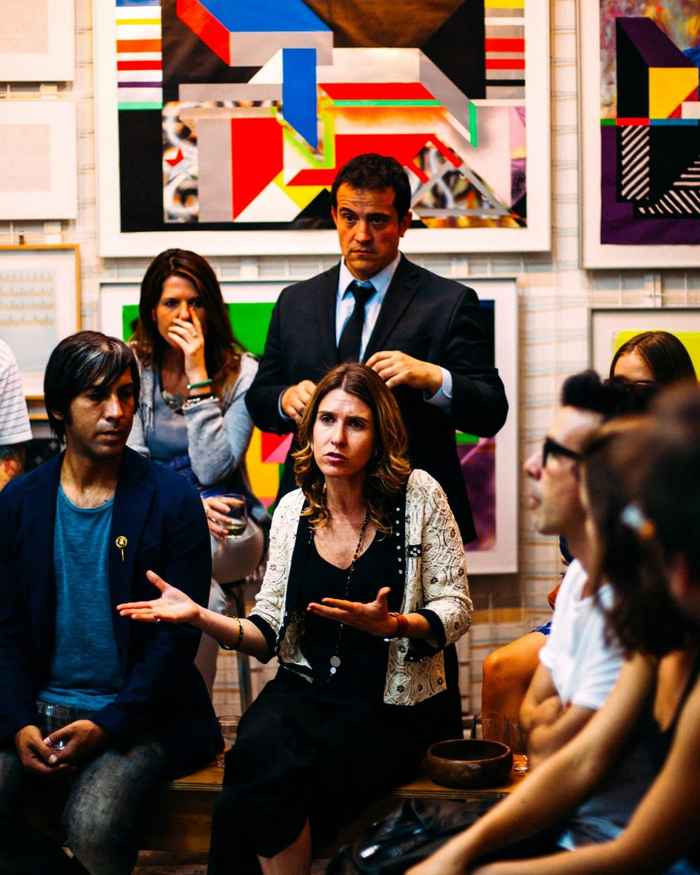
Bridges not Walls: Dialogue in Times of Polarisation will be taught for the third time in February 2027 as an interdisciplinary elective course run by the Institute for Interdisciplinary Studies, open to UvA undergraduate students, professionals and students taking the course as a minor. bijvakstudenten.
This course is part of the Empowered Minds-project, which aims to embed affective learning broadly within the UvA’s teaching programmes. Based on the course, lecturer Judith van den Boogert also developed the tool ‘The Volcano of Change’ for the Transition Makers Toolbox. This tool encourages dialogue about personal and collective thoughts, emotions and interpretations.