Winner Create a Course Challenge 2025 “Body and Biases: AI and Data Inequality in Healthcare”
1 December 2025
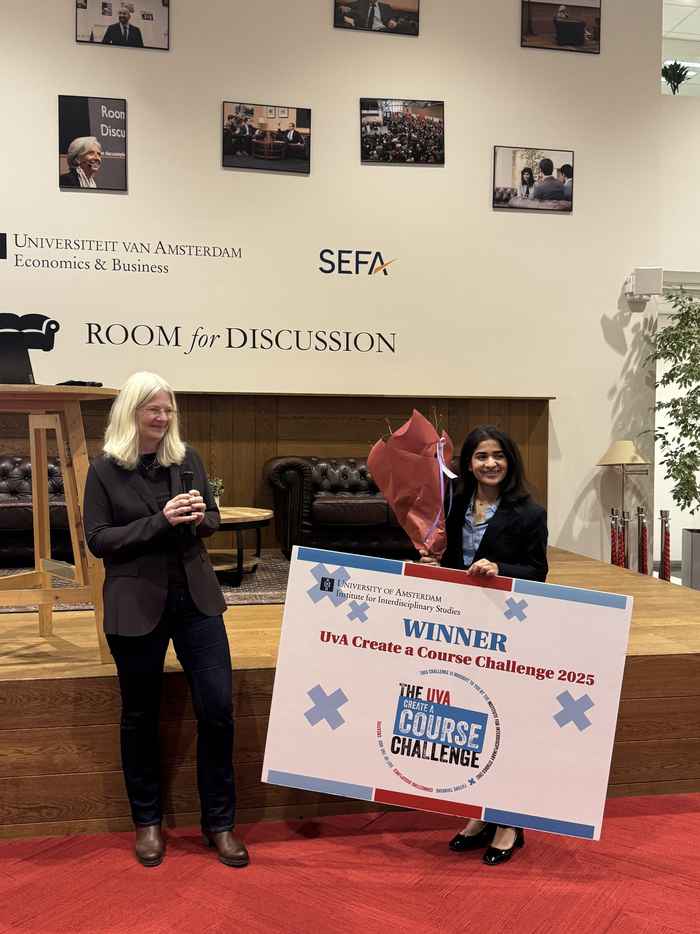
The five finalists of the Create a Course Challenge presented their ideas on Tuesday 25 November on the Room for Discussion stage at the Roeterseiland Campus. Led by presenter Roos Vervelde, the finalists took to the stage one by one, where they had eight minutes to pitch their idea to the audience and the three-member jury.
The jury consisted of Susan te Pas, Dean of the Faculty of Science, Mathematics and Informatics (FNWI), Lucy Wenting, Director of the Institute for Interdisciplinary Studies, and Victor Nieboer, Chair of the Central Student Council, Outreach and Inclusion.
The themes of this year's courses were very diverse. On the one hand, there were communication-oriented courses, such as The Politics of Being Heard: Persuasion Without Status and Political Journalism Practices in National and International Context: Comparing Perspectives and Practices. On the other hand, there were courses with a more personal development approach, such as Master the Art of Failing Successfully and Skills Lost in the 21st Century.
The jury emphasised that the choice was not easy. This year's presentations provided extra context to the submissions, shifting previous preferences. According to the jury, the winning proposal had the most elements of interdisciplinarity, was the most concrete in its elaboration and defined a contemporary social problem with particular sharpness. It was a close call, but in the end there can only be one winner.
The course: Body and Biases: AI and Data Inequality in Healthcare
The new course Body and Biases examines how data-driven healthcare can reinforce existing social inequalities. AI models increasingly determine who receives care, how risks are calculated and which bodies do or do not appear in datasets, thereby unconsciously excluding certain groups.
Students delve into medical sociology, science & technology studies and critical data science. The course requires not only theoretical understanding, but above all experience, analysis and questioning: students perform algorithmic audits on real health data and investigate where bias arises – and who is affected by it.
A unique part of the course is the collaboration with Amsterdam-based social partners, such as patient organisations and the Municipal Health Service (GGD). These organisations assist students in community-driven research and the development of concrete interventions for digital health equality. Coding is not required; critical and interdisciplinary thinking is.
The development of the course
The Body and Biases course will be offered in the first semester of the next academic year. To make this possible, Abhisree Bhattacharya and Rucha Kulkarni will be working with IIS educational developers to further shape the course in the coming period.
The Create a Course Challenge
Every year, the IIS organises the Create a Course Challenge, in which students are challenged to design a new UvA-wide elective course. This gives students a direct influence on the themes the university addresses and how contemporary education takes shape. The challenge ensures that education remains current, socially engaged and innovative – exactly what this winning course demonstrates once again.