The finalists of the Create Your Campus Challenge 2026 have been announced!
18 March 2026
The three selected experiments
Huiskamer Roetersstraat
The goal is to create an alternative world where streets exist for people, not for cars. The central island on Roeterstraat - the area initially reserved for the tram tracks - will become a temporary living room. Living rooms are the heart of the home, and our Huiskamer will be the centre of the street, open to everyone, with games to play.
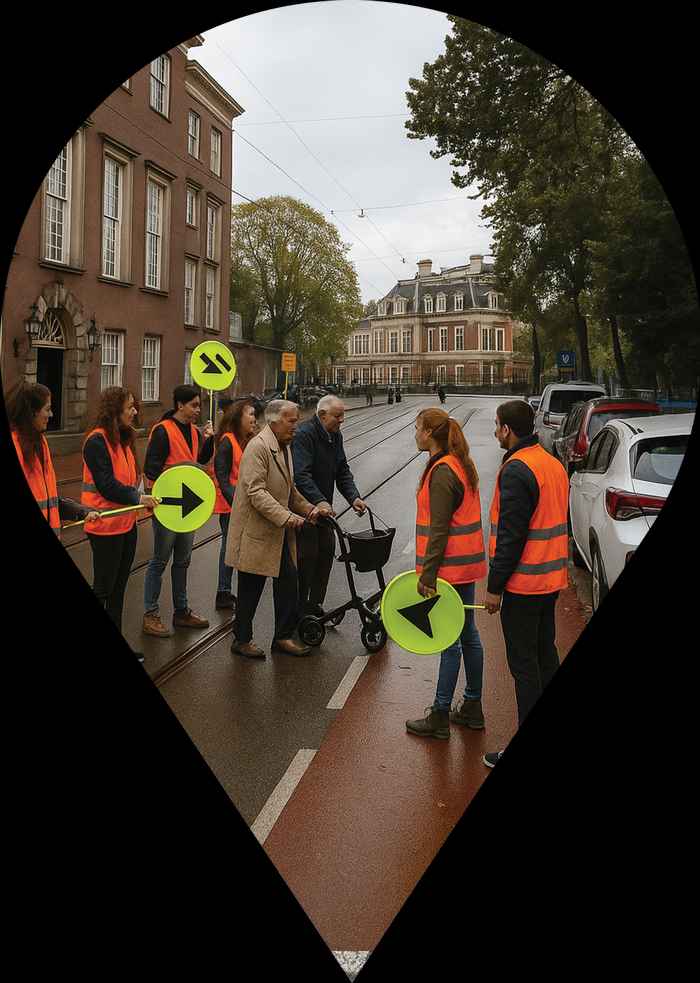
On a sunny day, we will install comfortable furniture (carpets, sofas, chairs, tables) on the island. To ensure safety for users of the living room, we will (1) keep the living room to unused parts of the street (between tram stops), and (2) encourage a “walking speed” (<6 km/hr) for all users of the roadways. To do so, we will set up signs at the entrances or the road, and volunteer “hosts” will wave signs when it is not respected. Furniture and games will be borrowed for the day, and additional second-hand furniture will be acquired as needed.
Team members
Juliette Leader
Pau Sisternas Mestre
Louise Raclet-Reymond
Felix Carayon
Instagram pitch
The Tracks to Table Project
The Tracks to Table Project is a temporary, reversible street experiment designed to test whether reallocating spatial priority from parked vehicles to people can measurably improve safety perception, social interaction, and liveability on Roetersstraat. The goal is not symbolic transformation, but structured, real-world testing of an alternative street hierarchy.
The motivation is structural: Roetersstraat currently prioritises traffic throughput over social and ecological value. The experiment addresses this imbalance by converting selected parking spaces into green islands and social infrastructure, visually redrawing the street layout, and introducing human-scale lighting and shared-priority cues.
The intervention consists of a clearly demarcated 100-meter stretch (will be implemented on Roetersstraat between the intersection with Nieuwe Prinsengracht and the intersection with Nieuwe Achtergracht) operating under a temporary shared-space logic. We contribute spatial design, coordination, volunteer facilitation, and evaluation. Required resources include municipal permission, removable barriers, planters, signage, and community participation.
Team members
Mina Tüzün
Sonia Zvalena
Instagram pitch
Livin'Room Roetersstraat
Livin'Room Roetersstraat tests what this street could be if we stopped treating it as a traffic corridor. Roetersstraat is a school street: students flow to campus, kids walk to Boekmanschool, elderly live at Sarphatihuis, but taxis speed through empty lanes. For 3-4 days during uni hours, we close vehicle lanes and lay grass sod over the asphalt, turning car space into green space where people sit, play, stay. Chalk games appear near school, plant libraries make greenery real and shared. A community afternoon wraps up the week. Cars take nearby canal streets instead. Tram keeps running. We're working with Green Office UvA and coordinating with Boekmanschool and Sarphatihuis to involve kids and elderly during the week. We need approval to close vehicle lanes and use tram lanes as a cycling corridor where trams and cyclists share space. Supplier delivers and removes grass, volunteers help install and remove sod. Main risks: grass damaged by weather (we'll use tarps), pushback from drivers (handled with early flyers and clear detour signs).
Team members
Muhammad Junaid
Ana Cordes
Claire Goeckner-Wald
Ethan Malech
Instagram pitch
The jury meeting
During the jury meeting, three selected student teams will pitch their street experiment for a more liveable Roetersstraat. The jury will then announce the winning team. It promises to be an event full of great proposals that will challenge the status quo of Roetersstraat!
The proposals will be judged by our jury members:
- Naima Bouchtaoui (City of Amsterdam)
- Klaas Hernamdt (resident of Roetersstraat)
- Jesse Jorg (creative professional, We the City)
- Sophia Blom (UvA Housing)
A people’s choice winner will also be announced during the jury meeting. From 19 March, you can vote for the videos of the #createyourcampus experiments via the @Placemakinguva Instagram account.
The winning street experiments will be carried out by the teams on 16 April as part of 'The week van de Rechtvaardige Straat'.
Create Your Campus is an initiative of Placemaking UvA and is organised by Katusha Sol and Marco te Brömmelstroet on behalf of the ‘Roetemakers’ coalition, comprising individuals, entrepreneurs and organisations who are actively working to improve Roetersstraat and are collaborating on this with the City of Amsterdam’s Year of the Pedestrian programme. The Create Your Campus Challenge is made possible in part by the City of Amsterdam and REC Impact.