Frontiers for Forensic Science: bringing forensic practice to the university
1 July 2026
On a Friday afternoon, while many students are heading to the pub, Room C0.110 at the Science Park is filling up. Students, alumni, and researchers are gathering for a session on the theme “Innovations for Forensic Biological Casework.” The afternoon consists of four presentations: two by Ph.D. candidates and two by researchers from the Netherlands Forensic Institute (NFI).
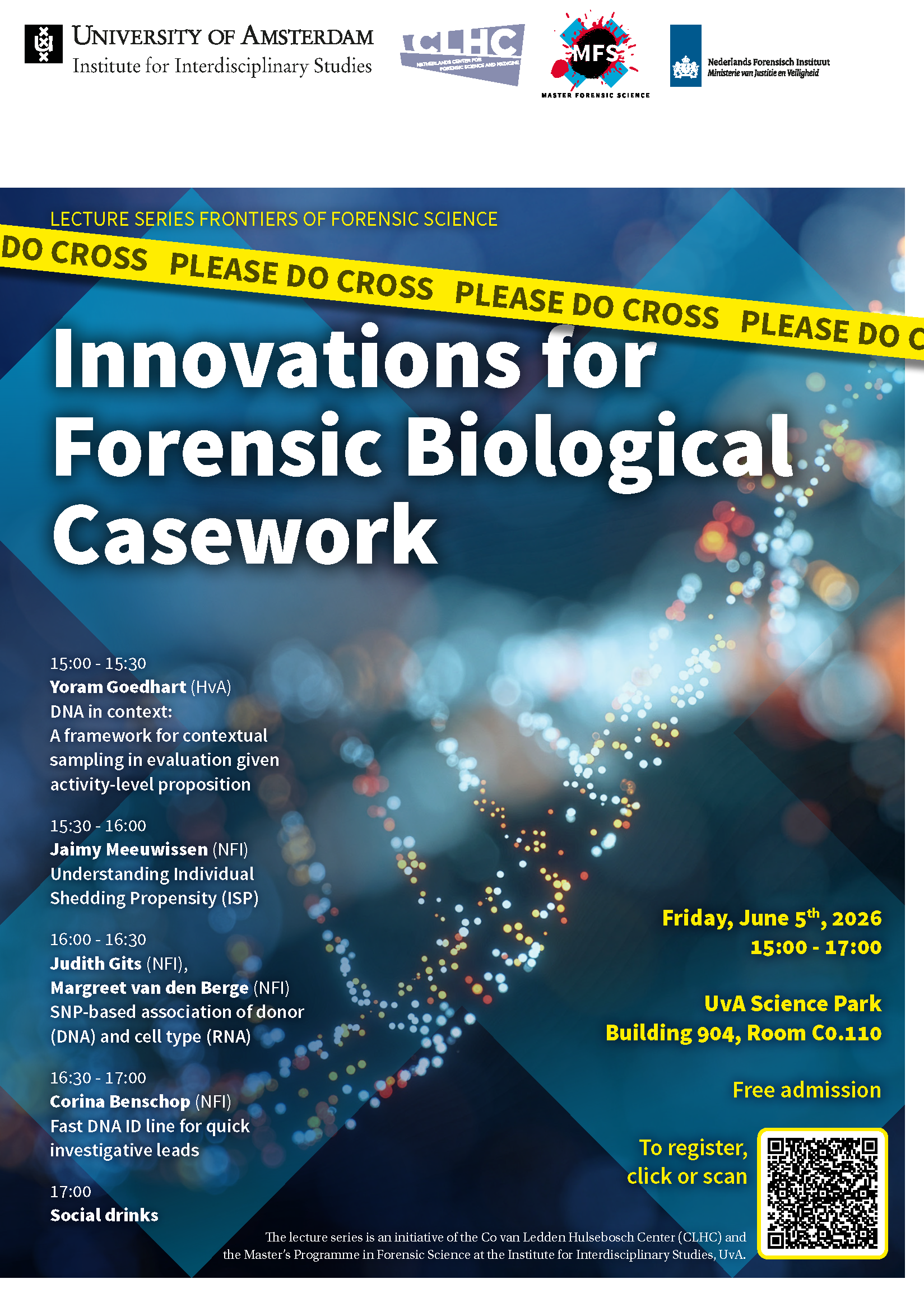
The first speaker, Yoram Goedhart, is conducting doctoral research at the Amsterdam University of Applied Sciences on the importance of environmental sampling at crime scenes. He emphasises that analysing a single object, such as a knife, is insufficient to draw conclusions about the nature of the DNA’s presence and a suspect’s role. DNA can end up on an object in various ways, for example through indirect transfer or because it has been present for some time. Goedhart argues that more extensive examination of an object’s immediate surroundings is essential to rule out alternative scenarios. For example, by also testing the table on which a knife is lying, one can better determine whether DNA ended up on the weapon through indirect transfer. Although his research is promising, he notes that practical implementation remains challenging, partly due to the additional costs involved.
The second speaker, Jaimy Meeuwissen, is an external PhD candidate at the Amsterdam University of Applied Sciences (HvA) and focuses on the phenomenon of “Individual Shedding Propensity” (ISP). This refers to a person’s tendency to shed biological material, such as skin cells. It has been known since the late 1990s that people differ in this regard, but much remains unknown about this phenomenon. Meeuwissen is investigating which factors influence ISP and how these vary among individuals. He distinguishes three categories: biological factors (such as skin characteristics), behavioral factors (such as hygiene and physical activity), and environmental factors (such as temperature and humidity). The instability of these factors makes the research complex. The proposal is therefore to include only (relatively) stable and intrinsic personal factors in the concept of ISP.
Meeuwissen emphasises that a better understanding of ISP is of great importance for forensic investigations. In cases such as femicide, where the perpetrator is often someone known to the victim, the presence of DNA can be difficult to interpret. Little is currently known about how much DNA from a partner or acquaintance is typically present on the body, and what effect ISP has on this. To investigate this, his team is launching a study in which samples will be taken from the bodies of fifty female participants. Hormonal factors, such as the menstrual cycle, will also be taken into account.
Following the presentations by the PhD candidates, Judith Gits and Margreet van den Berge of the NFI will take the floor. Their research focuses on the relationship between DNA and RNA in identifying cell types and donors. Although all cells contain the same DNA, the RNA differs depending on the cell type.
The researchers point out that, with current techniques, it is not possible to establish a link between cell type (RNA) and donor (DNA). At present, it is possible to determine—separately at the DNA and RNA levels—who may have contributed DNA to a sample and which cell types are present in a sample. However, it is not yet possible to link a specific cell type to a donor. In cases involving a mixture of multiple donors, the question “whose blood is it?” has remained unanswered until now. In recent years, the NFI has developed techniques that can address this question.* With funding from the Chain Innovation Steering Group, the application of this method in actual cases is being investigated in a pilot study involving the police, the Public Prosecution Service, and the NFI.
The final speaker of the afternoon is Corina Benschop, who also works at the NFI in the Biological Traces Department. Her presentation focuses on the broader question of who contributed the DNA found in a trace, such as at a crime scene. Over the years, the demand for DNA analysis has increased significantly. Although analytical techniques have become increasingly advanced and automated, the manual analysis and interpretation of DNA results remain labor-intensive and time-consuming**. This poses a challenge in forensic investigations, where speed is often crucial.

According to Benschop, one possible solution lies in automation. For several years now, various software tools have been available to support forensic DNA analysis. By integrating these into a fully automated process—from raw DNA profiles to reporting to the police and the Public Prosecutor’s Office—significant time savings can be achieved. The system developed is called the “Rapid DNA Identification Line” (Rapid ID Line). Benschop describes how this method has evolved from concept to practice, through research and case studies. Since 2025, all police units have been connected to the Rapid ID Line and receive the automated reports within a few days. The entire process is closely monitored, and in all cases, a manual report with any additional results is also provided. Research into the Fast ID Line continues, further expanding its potential applications. All in all, this approach represents an important step toward more efficient forensic DNA analysis.
At the end of the session, the participants leave the room feeling inspired. Some stay behind to discuss the research presentations, while others head to the reception, where the discussions continue. The event underscores the strong connection between academic education and forensic practice. For many students, this offers not only valuable insights but also a glimpse into their future field of work.
* The Cell2Donor assay used for this purpose is based on the fact that RNA varies by cell type; for example, blood cells have a different RNA composition than saliva cells. By analysing the RNA composition, the nature of the cell material can be determined. RNA is synthesized from DNA. The individual-specific point mutations derived from the DNA are therefore also present in the RNA. This means that RNA can be used not only to determine the cell type but also to link the cell type to individual donors.
** A manual DNA analysis can take several weeks, depending on the complexity of the case. In urgent cases, this turnaround time can be reduced to just a few hours, but this expedited method is very labor-intensive and suitable only for high-quality DNA traces. As a result, this approach can be used in “only” a few hundred—rather than thousands—of cases per year.