IP-Fellows serie - #1 Iris van Domselaar
What drives you as a professor of Philosophy of Law and Professional Ethics for Lawyers?
In my chair, I examine the law and legal practice from a philosophical perspective.
In doing so, I always try to combine the more fundamental philosophical questions with specific issues that arise in everyday legal practice. In the Netherlands, but also in an international context, there is increasing attention on what one can expect from lawyers from an ethical standpoint. Consider the climate crisis, the issue of tax avoidance, citizen-centred working, access to justice, the erosion of the rule of law and, of course, the rise of AI.
Against this backdrop, I have worked with colleagues at our faculty over the past few years to develop a coherent ethics programme that spans various subjects and disciplines. In this way, I aim, amongst other things, to contribute to the development of responsible legal professionals – professionals who can reflect meaningfully on the relevant ethical issues arising in the workplace. In one course, for example, we focus specifically on the ethical aspects of the work of lawyers in large organisations. Think of a government department, an implementing body such as the UWV or the IND, or a law firm in the Zuidas business district. I am delighted to see that my faculty offers so much scope for ethics in its teaching; that is not a given everywhere.
How did you come across the IIS IP Fellows programme?
The IP Fellowship actually ties in perfectly with what I’ve been working on over the past few years. It helps me to further develop the educational ambitions I already had and to ensure they are meaningful for the UvA as a whole. The programme lasts a year, so there’s no time to linger at the drawing board. In any case, over the years I’ve come to believe more and more in the value of a ‘bottom-up’ approach to educational innovation, with less time and money spent on retreats and design sessions that are sometimes far removed from the concrete reality of teaching. I like to work on educational innovation on the spot, in the places where the space, vision and positive energy of people are already present. Developing education together with enthusiastic colleagues, trying it out straight away and taking it a step further from there – I sometimes jokingly call this ‘bottom-up to the top’. With this fellowship, I also got down to the actual development quite quickly.
What are you currently working on?
Specifically, I’m working on three projects. The first project has just been completed, with excellent results. Together with a small project team comprising subject matter experts and educational specialists, we’ve developed a reflection book: ‘Lawyer from Day 1. Ethical Reflections for the Future’ for the first-year module ‘Legal Professions and Professional Ethics’, which is taken by around 600 law students. This links substantive material on professional ethics to more reflective and personal questions. What does this insight mean to you, how do you view a particular academic debate, and what do you take away from it? With this reflection booklet, we aim to give a real kick-start to the process that educational philosopher Gert Biesta calls ‘subjectification’ in the first year of the law programme. This is a process in which a student regularly asks themselves: how do I relate to the world? I believe that law faculties have an important social role to play here; they are training the lawyers of the future. As far as I’m concerned, every degree programme could give this dimension of education a little more attention.
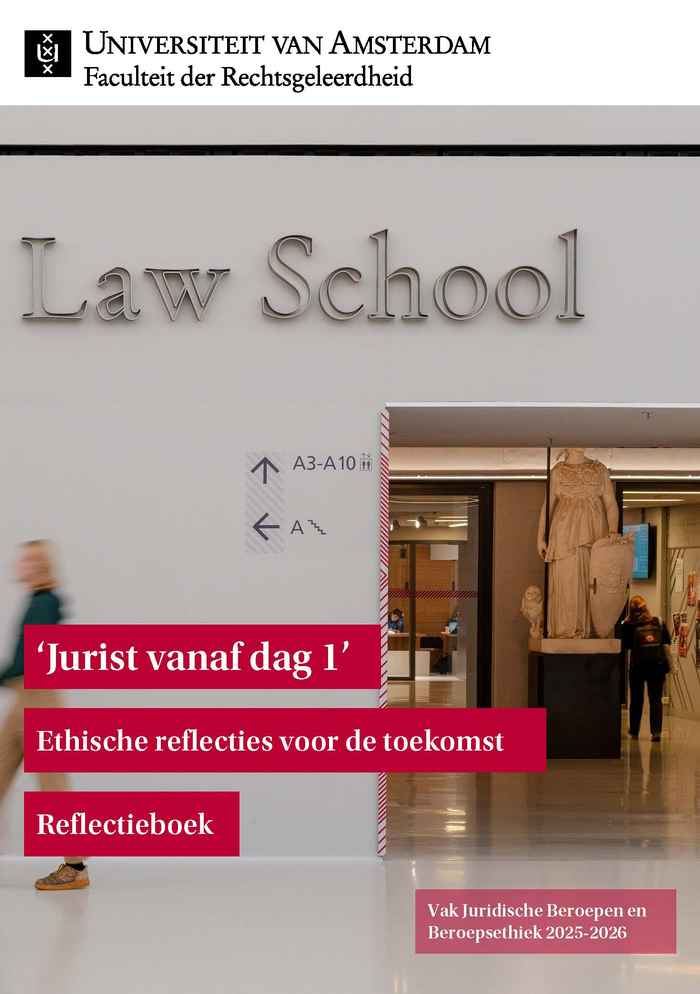
The reflection book is also designed to support ‘laptop-free’ teaching. Laptop-free teaching means that students do not use laptops during seminars, thereby creating more space for concentration, writing with pen and paper, and active participation in discussions. The reflection book provides guidance in this regard, precisely because it does not involve a screen. Our aim with the first-year ethics course is to encourage ethical reflection and critical thinking. Of course, this is only possible with sufficient moments of quiet reflection and focus. By having students write in the book with pen and paper during seminars, we hope to contribute to this. We haven’t been doing this for very long, but we are already receiving positive feedback. There is greater concentration and more opportunity to really engage in conversation with one another.
I developed the reflection book together with Imber van Dijk (TLC-FdR), Wytze Schaap (FdR), Machiel Keestra (IIS) and Jasper ter Schegget (IIS). We hope it can serve as a prototype for other faculties; it would certainly be wonderful if this method could contribute to more reflection and thus more subjectification across the entire UvA education system. It would also help to further flesh out the concept of academic citizenship, one of the key priorities of the UvA’s educational mission. In this regard, I am in favour of an integrated approach in which cognitive and affective learning truly go hand in hand. As far as I am concerned, these are ultimately not separate domains.
What does the second project you’re working on involve?
The ultimate aim was to develop a UvA-wide elective course on Ethical Mastery for Master’s students and professionals, so that they can learn with and from one another as co-learners. To this end, I have already opened up our Master’s course ‘Legal Practice and Professional Ethics’ to professionals as a pilot scheme. I am also in discussion with colleagues from other faculties to see if and how we could gradually implement this UvA-wide ethics course. I believe that the university, precisely because of its independence and distance from the day-to-day workplace, can offer significant added value to ethics education for professionals.
And your third project?
As part of my IP fellowship, I am also involved in the placement programme at our faculty, based on the idea that access to the law begins at the Faculty of Law itself. In our curriculum, we want to give students more exposure to legal professions that focus on ordinary citizens. With this project too, I am looking at how it can contribute to the UvA’s mission as a whole. I believe, for example, that setting up a UvA-wide internship office to support all internship modules across the UvA could also be an excellent way to further realise the IP theme of a fair and resilient society within education.
What are your thoughts about the IP Fellowship?
Very positively! You work on your own projects but meet regularly with the other IP fellows to exchange ideas. That’s inspiring. We only have a year, so we really focus on what we can achieve in such a short period, and it’s great to be working in such an innovative way, truly driven by inspiration and vision, with a fantastic support team from IIS. Normally, with a project proposal, more time is spent on the preparatory phase; here, with the support of the people from IIS, I was able to start piloting straight away. So it’s really ‘learning by doing’.
What are your ultimate goals?
Above all, I hope that the topic of subjectification will be placed high on the educational agenda within the UvA. Students need this; the current generation is more conscious of how they want to live, according to which values, and how one relates to what is happening in the world. All UvA students will soon have a role to play as professionals in a society facing major challenges. Towards the end of my fellowship, I would like to organise a symposium on subjectification in academic education. What kind of professional do I want to be, and what is the university’s role in addressing this question for students? That is the core of my fellowship.
Stay tuned, because soon we’ll also be talking to the other IP fellows about their projects and experiences within the IP Fellowship!