Rethinking Sustainable Societies
This minor aims to provide you with new perspectives by exploring new lines of thinking from different disciplines across the faculties of the UvA and to allow you to rethink what a sustainable society would or should look like.
For over half a century, scientists have warned us about the impacts of climate change and environmental destruction. While the Club of Rome, the Brundtland report and the IPCC reports gain a lot of attention from media and policymakers, they have not led to a clear change in terms of human impact on the health of the planet.
Yet while many criticize the traditional sustainability agenda for being inadequate and weak, it is simultaneously being targeted by political leaders for being unnecessary, woke, and expensive.
In other words, the traditional discourse around sustainability is not only failing to inspire a just transition, but also at risk of being replaced with regressive, exclusivist and exploitative alternatives.
It seems we are in need of new political, economic and institutional models that not only help us move beyond the sustainability stalemate, but also reinvigorate and strengthen the belief in, and commitment to, a world that has enough for everyone and everything.
This minor invites you to explore - together with a wide range of innovative thinkers and practitioners - what these models and perspectives might look like.
Programme
The minor covers 30 EC and can be completed in one semester. It includes one compulsory course and one elective in study periods 1, two elective courses in study period 2 and one compulsory course in study period 3. Each course consists of 6 EC.
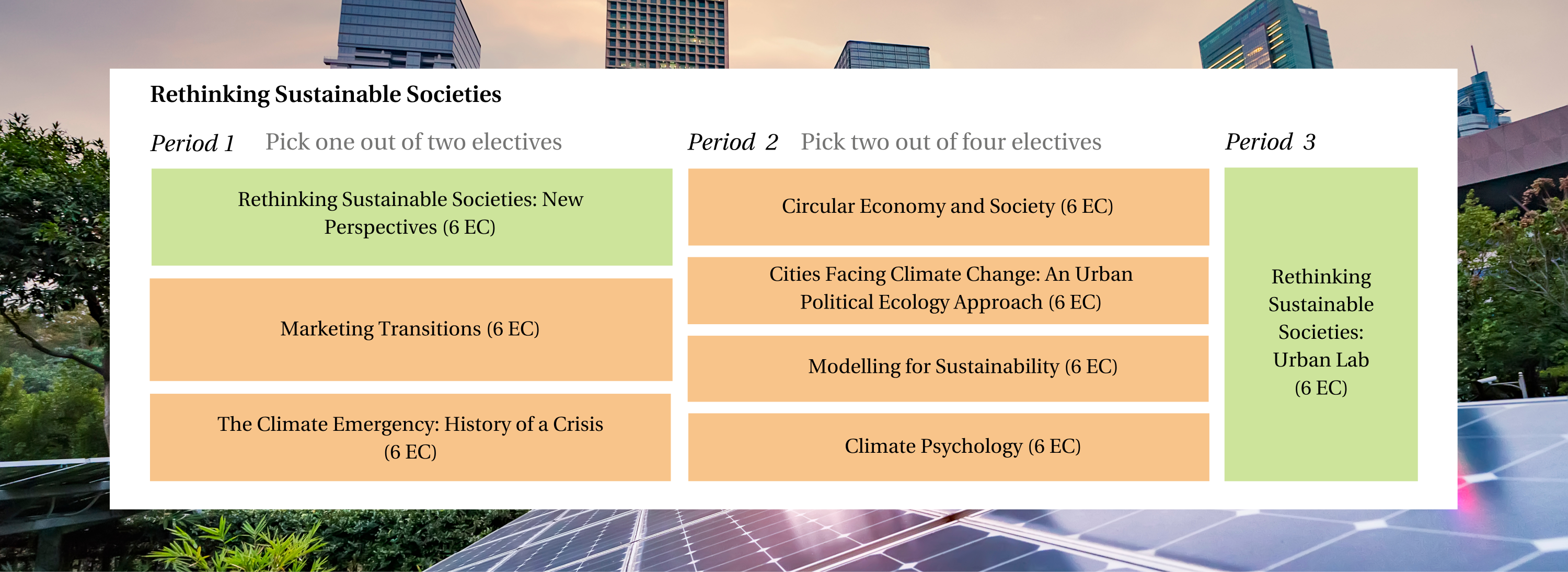
As mentioned in the introduction, this programme aims to offer you new perspectives. But in order to do that, a thorough understanding of how we got there is also necessary. This is why the first study period offers two parallel courses. The first course, hosted by the Institute for Interdisciplinary Studies, is about new perspectives and offers insights from different disciplines on how to rethink what a sustainable society is or should be. At the same time, you will either study how we actually got into this situation or the role of marketing in a sustainable society as marketing is at a crossroads - will it continue to drive unsustainable consumption, or can it become a force for good?
The elective course The Climate Emergency: History of a Crisis will offer the essential historical perspective to understand how the climate crisis evolved and how science and policy responded. The other elective course Marketing Transitions, you'll explore how businesses, governments, and individuals can transition toward sustainable models that benefit society and the planet. Join this course offered by the Faculty of Economics and Business to rethink marketing’s role in shaping a sustainable future.
The second study period offers you a choice of two out of four courses that have a specific focus:
- Circular Economy and Society looks at the transition from a linear economy that uses raw resources and a lot of waste to a circular system where all the waste is reused as a prime resource so that it is no longer necessary to use raw resources. This should lead to an end to overexploitation and pollution through waste. The course is offered by the Faculty of Economics and Business.
- The course Cities Facing Climate Change: An Urban Political Ecology Approach makes explicit the underlying power relations that have created this exploitative and inherently unequal economic and political model. It shows how the ‘construction’ of nature is both a source of power structures as well as a consequence of power structures. With a particular focus on the urban as the loci of power and capital, it addresses structural faults within the current system. This course is offered by the Faculty of Social and Behavioral Sciences.
- Modelling for Sustainability is offered by the Faculty of Science and teaches you the fundamentals of modelling and quantitative decision-making. This course explores cirital models shaping our understanding of climate change, population growth, natural disasters (floods, wildfires), and epidemiology. Get hands-on experience implementing simple models using basic programming concepts. Gain the skills to analyze the science driving predictions and planning for a sustainable future.
- Current Topics: Climate Psychology introduces students to the psychological (cognitive, affective, motivational, social) and behavioral processes that have contributed to climate change, and our psychological and behavioral responses to it. These psychological insights can play a role in mitigating and adapting to a rapidly changing climate. This course is offered by the Faculty of Social and Behavioral Sciences.
The minor is completed with the Urban Lab in study period 3. In this course, you work on an assignment given by a societal partner. In this case, the municipality of Amsterdam will host you and provide you with a sustainability challenge. Having gained a broad palette of perspectives on the topic, you can now provide valuable input to current policymaking in the city.
Entry requirements
You can apply for this minor if you are a Bachelor’s student and have obtained at least 60 EC from university-level courses at the time of application.
This minor is open to international students and ‘bijvak’ students from other Dutch universities. This minor is part of the Bèta-gamma bachelor’s degree programme. For your registration as an elective student, select the Bèta-gamma – elective (bijvak) degree programme in Studielink.
Enrolment and Admission
The registration period for a minor in the academic year 2026-2027 is open between April 1st and May 6th 2026.
A limited number of fifty places are available for this minor. If there are more applications than available places, a draw will determine your placement.
Contact us
This minor is organised by the Institute for Interdisciplinary Studies. For questions regarding practical matters or the minor programme, you can contact us via keuzeonderwijs-iis@uva.nl.
- Mode
- Full-time
- Credits
- 30 ECTS, 6 months
- Language of instruction
- English
- Starts in
- September